 By logical dot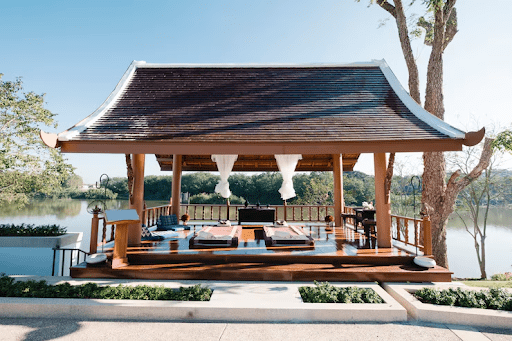
There’s a reason timber has been used for outdoor structures for centuries. It weathers beautifully, carries real visual weight, and ages into a landscape rather than looking placed on top of it. For homeowners investing in an outdoor living area, a timber gazebo is one of the few additions that genuinely improves with time rather than degrading.
But not all gazebos are created equal — and the decisions you make before construction begin shape everything that follows.
Why Timber Outperforms Other Materials for Gazebos
Walk through a garden centre and you’ll find gazebo kits in vinyl, aluminium, composite, and pressure-treated pine. They’re accessible and affordable, and some of them look fine on the day they’re installed. But they tend to look exactly the same — or worse — five years later.
Structural timber is different. Douglas fir, western red cedar, and heavy-timber pine all develop character over time. Cedar greys naturally to a silver tone that most homeowners find more attractive than the freshly-cut original. Heavy timbers show the grain and texture that make each structure genuinely unique.
Beyond aesthetics, heavy timber construction is structurally robust. The joints are cut to interlock rather than relying purely on metal fasteners, and the mass of the material provides stability that lighter structures can’t match. A well-built timber gazebo doesn’t flex or rattle in the wind.
Key Design Decisions
Open vs. Partially Enclosed
Traditional gazebos are fully open on the sides — a roof structure supported by posts, with railing or lattice panels as optional additions. Partially enclosed designs incorporate knee walls or more substantial infill panels for privacy or weather protection. The choice depends on how you plan to use the space and what climate conditions you’re working with.
Roof Style
Common roof profiles for timber framed gazebos include:
- Hip roofs — four sloping sides meeting at a central peak; the most traditional form
- Gabled roofs — a single ridge with two sloping faces; suits larger rectangular footprints
- Octagonal roofs — eight panels meeting at a central peak; the classic Victorian-era form
The roof profile affects both the visual character and the structural requirements. Octagonal designs, for example, have more complex joinery at the peak and generally require more fabrication time.
Size and Scale
Gazebo proportions matter as much as the design itself. A structure that’s too small for the space it occupies reads as an afterthought; one that’s too large overwhelms the garden. A general rule of thumb: the gazebo footprint should occupy no more than about 20–25% of the total outdoor space, with adequate clearance on all sides for movement and planting.
Timber Species: What Actually Lasts Outdoors
Western Red Cedar is the most commonly used species for exposed outdoor timber structures. It has natural oils that resist rot and insect damage without chemical treatment, a stable grain structure that minimises warping, and a pleasant aromatic quality. It’s also lighter than many hardwoods, which simplifies installation.
Douglas Fir offers more structural strength than cedar — useful for larger spans and heavier load requirements. It takes finishes well and has excellent dimensional stability when properly dried.
Glulam Beams (glued laminated timber) allow for longer spans and more design flexibility than solid sawn timber. They’re less susceptible to checking (surface cracking) and can achieve curves that would be impossible with solid material.
Site Preparation and Foundation
A timber gazebo isn’t a lightweight garden ornament — it needs a proper foundation. The most common approaches are concrete footings at each post location, a full concrete slab, or helical piers for sites where digging full footings is impractical.
Local building codes typically govern what’s required based on the structure’s size and the frost depth in your region. Most jurisdictions require a permit for permanent structures, and a proper foundation is part of that approval.
Drainage is worth considering before the foundation goes in. A gazebo built over poor drainage will develop moisture issues at the base of the posts over time. Grading the site slightly away from the structure — or incorporating gravel drainage below the footings — adds years to the lifespan of the timber.
Finishing and Maintenance
Raw timber left untreated will weather over time. Cedar greys naturally; other species may develop surface checking or discolouration. Whether you treat the wood depends on whether you want to maintain the original appearance or allow the natural patina to develop.
For a more finished look, penetrating oil finishes — rather than film-forming products like paint or solid stain — are generally preferred for outdoor timber. They allow the wood to breathe, require less surface preparation to recoat, and show the grain rather than obscuring it.
According to research from the Forest Products Laboratory, a division of the USDA Forest Service, wood treated with quality penetrating finishes in outdoor environments can maintain its structural integrity and appearance for decades when recoated on a regular schedule. The maintenance commitment is modest compared to the lifespan of the structure.
The Long-Term Value of Doing It Right
A timber gazebo built from quality material with proper joinery and a solid foundation isn’t just an outdoor feature — it’s a permanent addition to the property. Unlike most garden accessories, a well-built timber structure appreciates with the landscape around it.
Getting the design right before fabrication begins — the proportions, the species, the roof profile, the foundation approach — is far more cost-effective than changes mid-build. The time invested in planning pays back every year the structure stands.